
Line marking where GPS does not reach
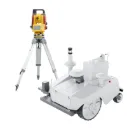
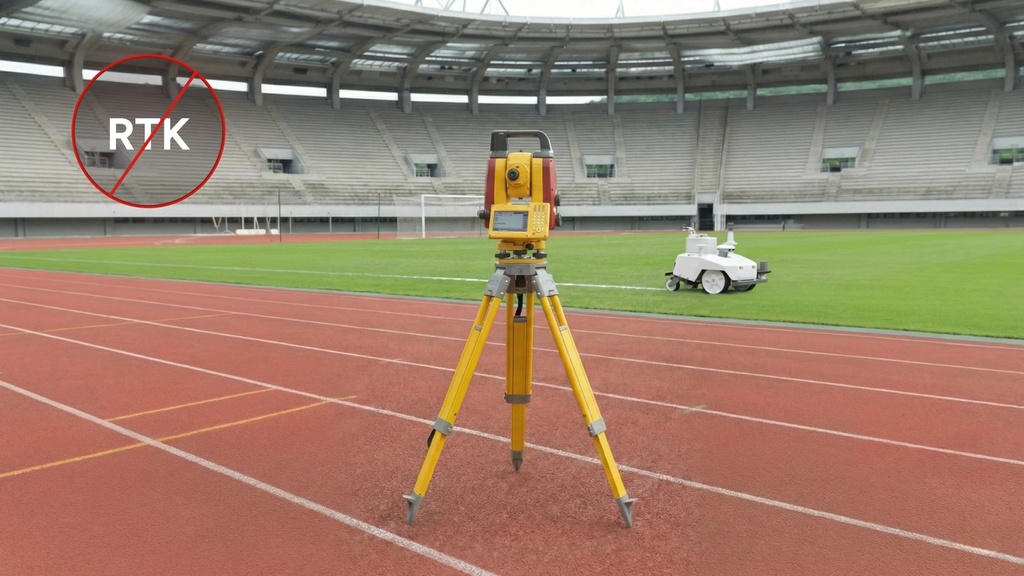
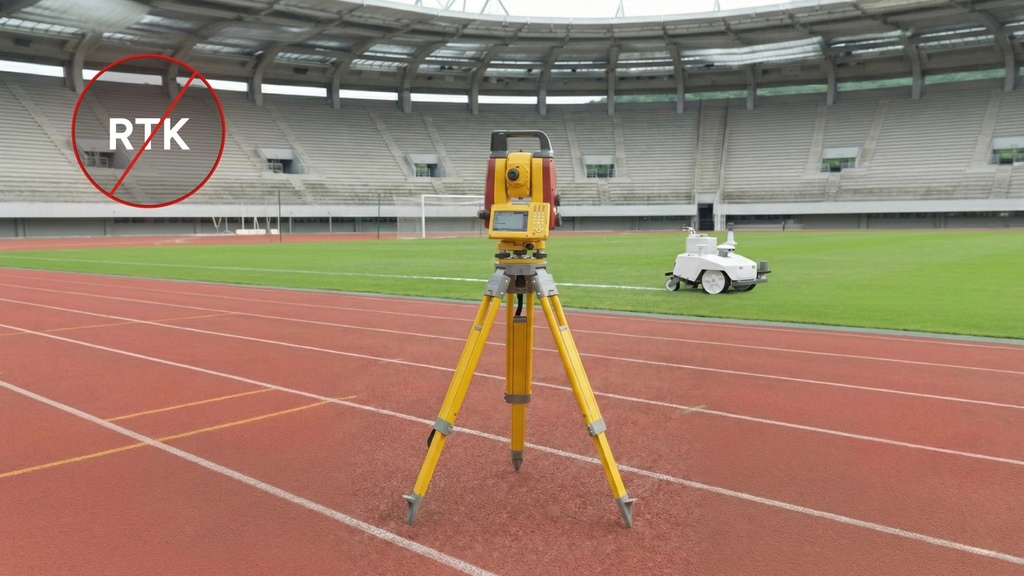
FJD PaintMaster Ultra is an autonomous line marking robot for venues where the satellite signal is not enough. Instead of relying on GPS, a total station follows the robot with a laser and measures its position down to the millimetre. That lets the robot mark lines indoors, under stand roofs, next to buildings and under trees, where a regular RTK-based line marker loses accuracy.
How it works
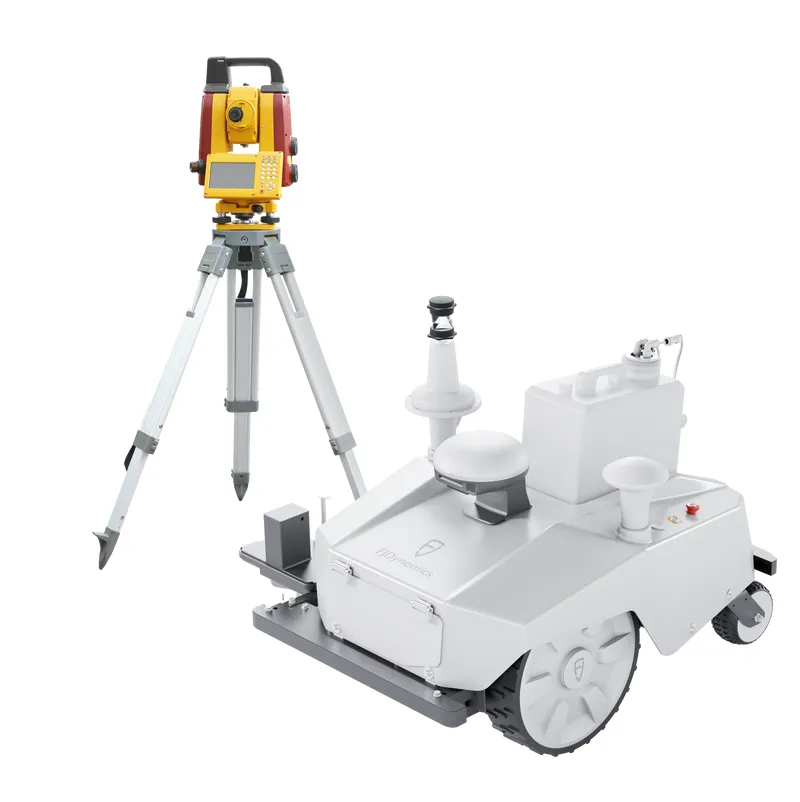
PaintMaster Ultra is built on three parts that work together: the total station, the prism on the robot, and the robot itself.
The total station
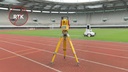
A total station is a surveying instrument that is set up on a tripod beside the pitch. It sends out a laser beam and measures both the angle and the distance to a target, which gives the position of that target with very high accuracy. FJD describes it as a total station with automatic prism tracking: it locks onto the robot and follows it throughout the job.
The prism
The robot carries a prism on a pole. A prism is a reflector that sends the laser beam straight back to the total station. It is what the total station sees and tracks. By measuring to the prism over and over, the total station always knows exactly where the robot is, and that position is used to steer the robot along the line.
The laser
The laser in the total station measures the distance to the prism. Because the position comes from laser and angles and not from satellites, it works where GPS is blocked: indoors, under roofs and between tall buildings. FJD states that the robot then operates independently of satellite signals.
The robot
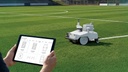
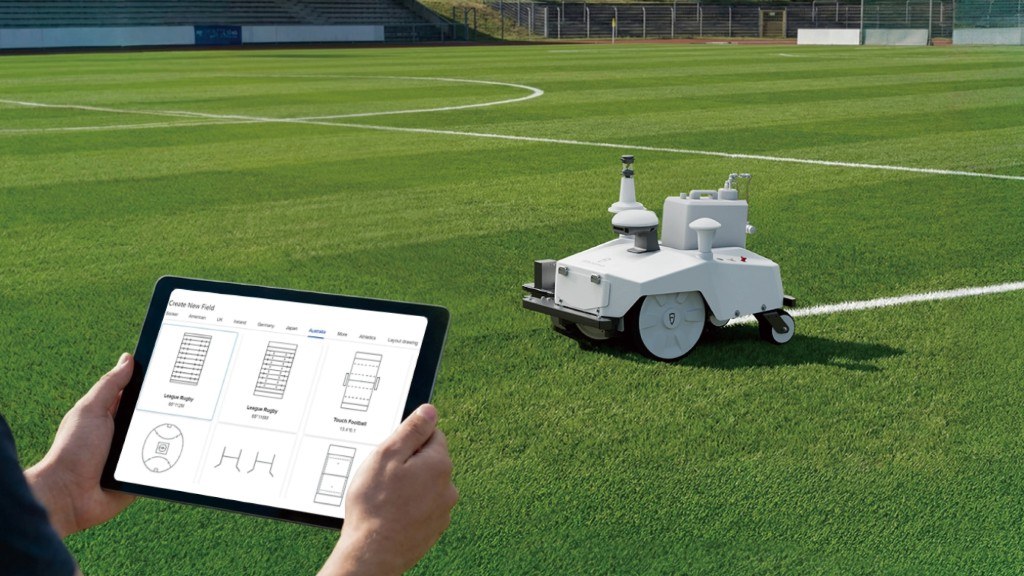
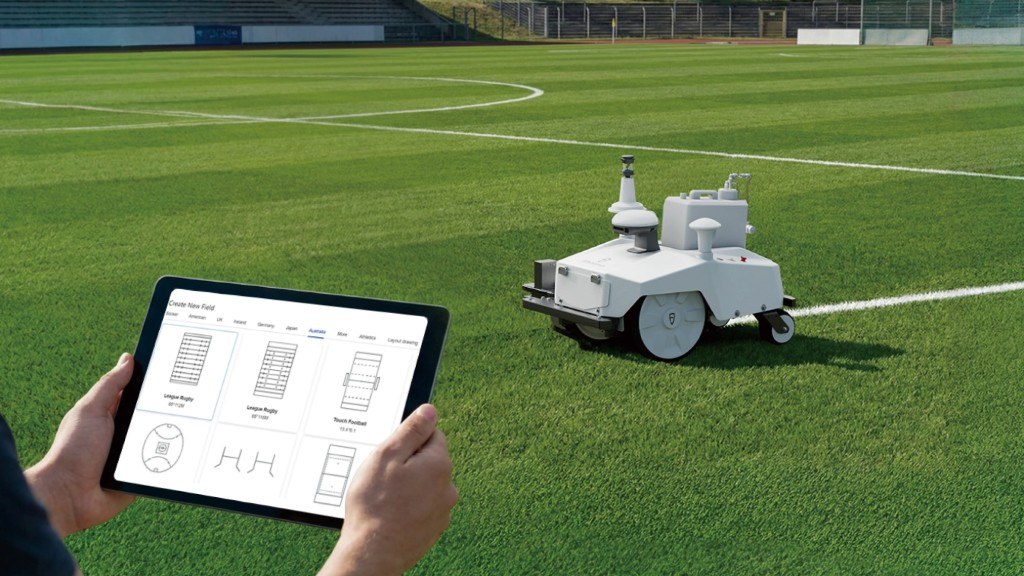
The robot follows the lines you have drawn on the tablet. An IMU (inertial navigation) helps it keep straight lines straight and curves smooth, even on uneven turf, and studded tyres give grip on wet grass. The paint system regulates the pressure so the paint is applied evenly.
Two ways to position: total station or RTK
The robot has both. The total station gives millimetre-level accuracy where the sky is blocked or the satellite signal is weak. GNSS with RTK gives centimetre-level accuracy on open ground with a clear view of the sky. That is why the specification lists the positioning system as total station and GNSS.
Where Ultra makes the difference
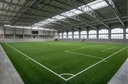
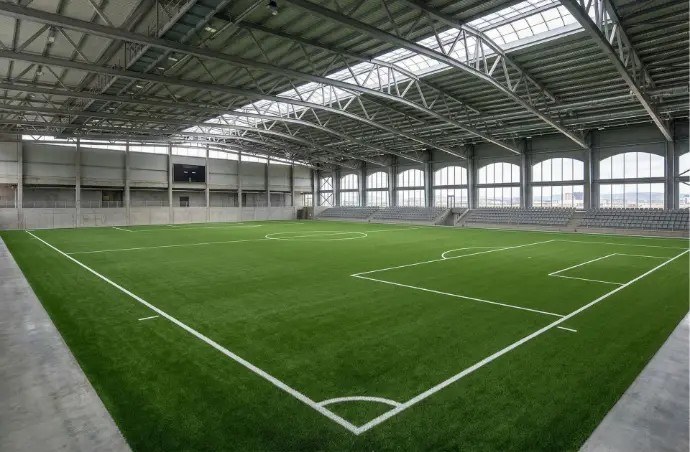
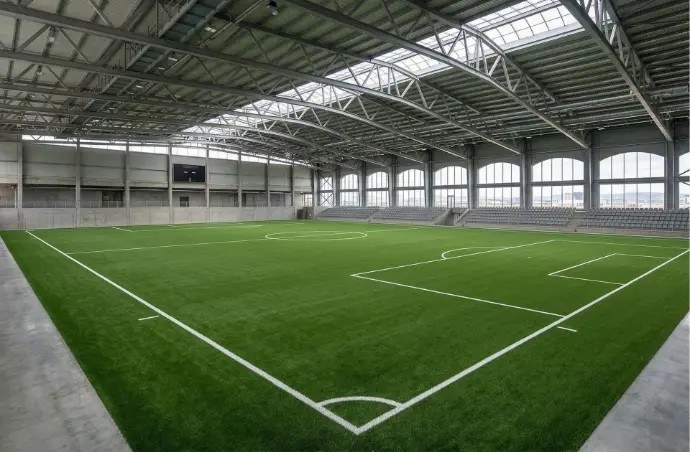
- Indoor arenas and halls, where there is no satellite signal at all
- Stadiums with stand roofs and overhangs that block the sky
- Pitches next to buildings or under dense tree cover
- Tournament pitches where line width and line position must be exact. FJD states that Ultra meets the requirements of FIFA, NCAA and other elite tournaments
Digital planning and records
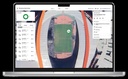
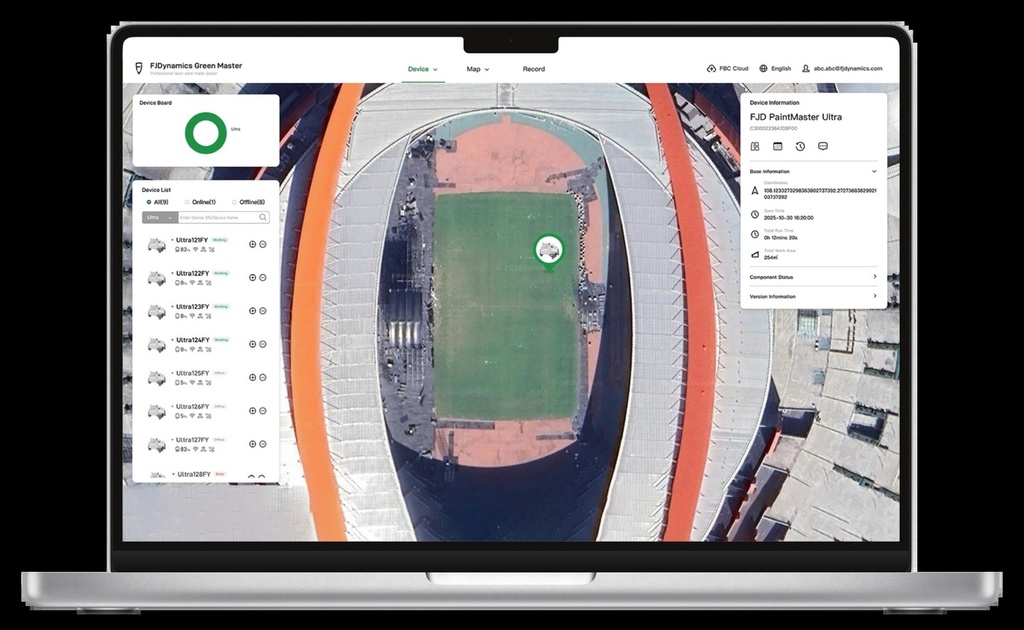
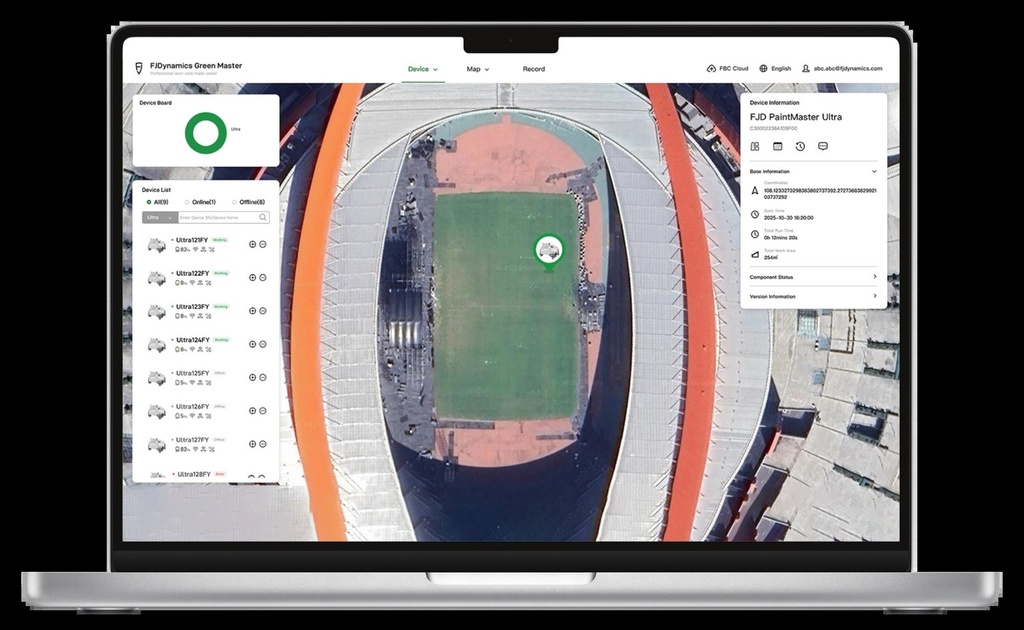
Built-in templates for international sports layouts let you generate lines in one click and edit the path in real time on the tablet. The system logs time, coordinates and key parameters for every session, so every job leaves a traceable record. Fleet and site management runs in FJD GreenMaster, and the PaintMaster Simulator lets you preview the marking path in advance to avoid mistakes.
One person instead of a crew
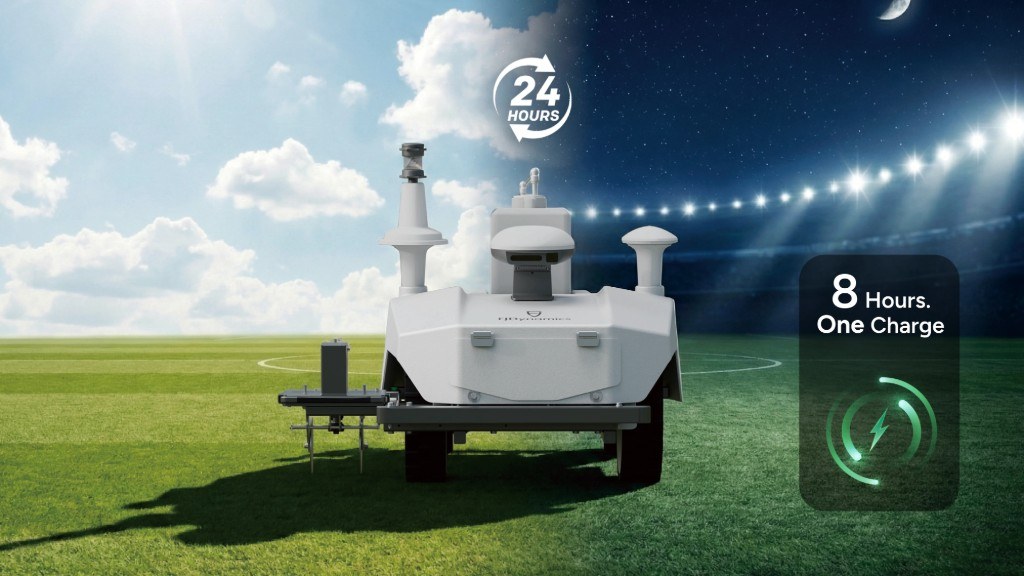
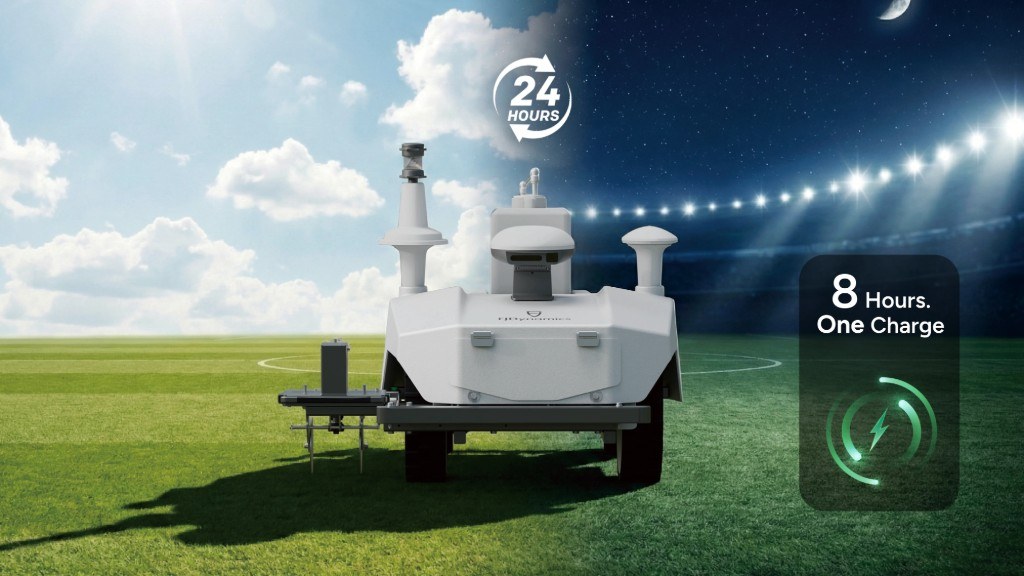
FJD states that the automated solution replaces a traditional three-person crew, so one operator can complete professional marking for a football, baseball or rugby pitch. According to FJD a standard 11v11 pitch takes about 30 minutes. The robot runs for up to 8 hours per charge and supports quick battery swapping for continuous day and night operation.
PaintMaster Ultra or PaintMaster Pro?
If you mainly mark on open pitches with a good view of the sky, centimetre-level RTK accuracy is often enough, and PaintMaster Pro is an alternative. Choose Ultra when the pitch is covered, indoors or surrounded by buildings and trees, or when you need the highest precision.
Common questions
What is a prism and why is it needed?
The prism is a reflector on the robot. The total station aims its laser at the prism, measures angle and distance, and from that calculates the robot's position. Without the prism the total station would have nothing to lock onto.
Does it really work without GPS?
Yes. With the total station the position comes from laser and angles, not from satellites. As with all laser measurement, the total station needs a clear line of sight to the prism, so it is placed where it can see the area the robot will work on. Contact us if you want us to go through your venue.
How accurate is it?
FJD states millimetre-level accuracy with the total station, specified as ±3 mm. With GNSS and RTK on open ground the accuracy is at centimetre level.
How long does it run and how long does it take to charge?
Operating time is up to 8 hours and charging takes about 5 hours (1 kWh, 48 V). The battery can be swapped quickly so the robot can keep working.
What surfaces is it made for?
PaintMaster Ultra is built for marking grass pitches and has studded tyres for wet or low-grip grass. For parking lots and other hard surfaces we also offer the PL01. Ask us which robot fits your venue.
What is included?
According to FJD's specification the positioning system, total station and GNSS, and the operating tablet are part of the standard configuration. We confirm the exact scope of delivery in the quotation.
Want to see PaintMaster Ultra in action? Contact us for a demonstration and a quotation.
| Hinder Undvikning | Camera-based obstacle avoidance and front and rear bumpers |
| Mått | 1074 × 1023 × 672 mm |
| Vikt | 75 kg |
| Linjebredd | 6–17 cm |
| Märkhastighet | 1–3 km/h |
| Färgkapacitet | 25 L |
| Batterikapacitet | 1 kWh / 48 V |
| Batteritid | 8 hours |
| Laddningstid | 5 hours |
| Snabbt batteribyte | Stöds |
| Driftstemperatur | 5–45°C |
| IP-klassning | IPX3 |
| Anslutning | 4G, Bluetooth and wireless |
| Produkttyp | Linjeringsrobot |
| Positioneringsnoggrannhet | ±3 mm (total station) |
| Positioneringsteknik | Total station with prism (laser) + GNSS/RTK |