
Ball picking is the job nobody at the range talks about and everybody has to do. It happens before opening, after closing, or with part of the range roped off — and it quietly eats hours every week of the season.
RoboService follows the market for autonomous turf equipment closely, and one machine has come up often enough during 2026 to be worth a proper look: the Wayrobo WayPick 2, a self-driving ball picker built specifically for the driving range.
What this article is — and is not
RoboService does not sell the WayPick 2. This is market watch: we have read the manufacturer's material and believe the concept is relevant for Swedish facilities. Every performance figure attributed to Wayrobo below is the manufacturer's own claim, not a promise from us. Pricing for the Swedish market is not established — if the concept is interesting for your facility, get in touch and we will look at it together.
The hidden cost of picking balls
On most ranges the picking is done by one person on a tractor or a utility vehicle towing a collector. Three things follow from that, and none of them show up on an invoice.
It costs opening hours. If picking has to happen while nobody is hitting, the range is either closed or partially closed for the duration. On a busy summer evening that is revenue walking away.
It puts a person in the landing zone. Anyone who has driven a picker knows the sound of a ball hitting the cage. Protective screens help, but the safest range is one where nobody has to be out there at all.
It occupies staff who are needed elsewhere. The hours spent driving in circles are hours not spent on greens, bunkers, tees or members.
What an autonomous picker actually changes
The interesting part is not that a robot can pick balls. It is when it can pick them. A machine that navigates in the dark can do the entire job between closing and opening, which turns picking from something that interrupts play into something that has already happened when the first player arrives.
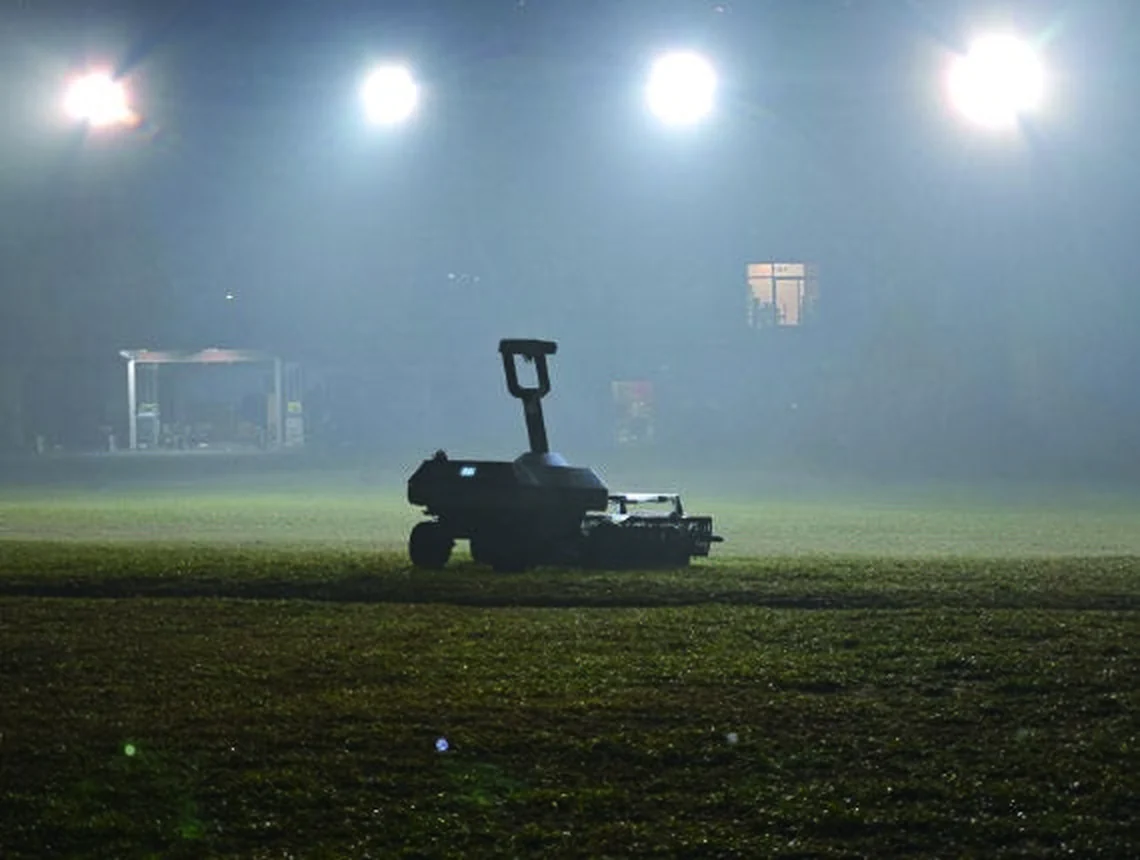
Wayrobo states that the WayPick 2 completes its full workflow at night using LiDAR, GNSS and headlights.
What the WayPick 2 is
The WayPick 2 is built by Wayrobo Pte. Ltd. in Singapore. It drives itself around the range, collects balls into a towed collector, returns to an unloading station when the basket is full, empties itself and goes back out — without an operator at any point in the loop.
These are the manufacturer's published specifications:
| Dimensions, robot | 1.43 × 1.09 × 1.58 m |
| Dimensions, with collector | 2.91 × 1.59 × 1.58 m |
| Drive | 4WD, four independent motors, suspension on all wheels |
| Navigation | GNSS RTK + IMU |
| LiDAR | Hybrid solid-state |
| Camera | Dual camera, 180° binocular |
| Collection capacity | Up to 2,000 balls per round |
| Max slope | 28 % (15°) |
| Max speed | 7 km/h |
| Coverage | Max 10,000 m² per hour |
| Recommended area | Under 50,000 m² |
| Battery life | Typically 10 hours |
| Charging time | 6.5 h (110 V) / 5.5 h (220 V) |
Wayrobo also claims that a single unit can cover up to 50,000 m² and collect up to 40,000 balls in one day with no human intervention, and that a range can save up to USD 40,000 a year in labour with zero overtime. Those are the manufacturer's figures and we have not verified them on a Swedish facility.
The features built for range work
Several functions are clearly designed by someone who has spent time on a range rather than in a lab.
Density heat map. The 180° binocular camera scans how the balls are actually distributed and plans a route that prioritises the dense areas first, instead of driving a fixed pattern across an empty outfield.
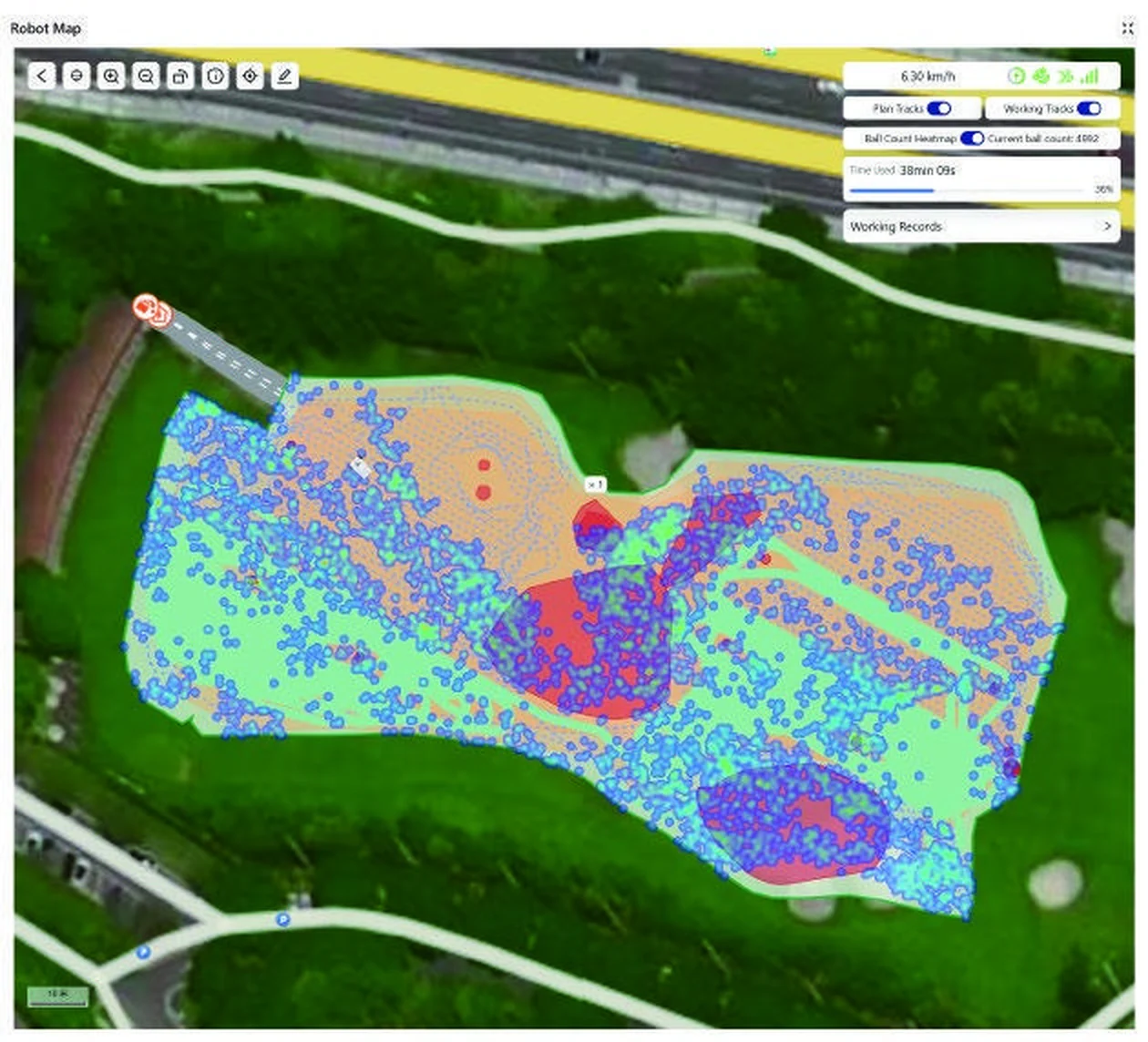
The control app builds a density map of the range and counts collected balls live. Screenshot from Wayrobo's material.
Hot zones and temporary no-go areas. Areas with a high landing probability can be marked as priority; tees, water, bunkers and yardage markers can be fenced off in the app, permanently or for a single session.
Turf protection mode. When efficiency is not the priority, the machine can trade speed for a gentler pass over the grass.
Fleet operation. Several units can work the same area at once and calculate their own routes without getting in each other's way.
Obstacle handling. Hybrid solid-state LiDAR and binocular vision feed an automatic emergency braking system that slows or stops the machine and then reroutes it. The body is built to take a direct hit from a ball, and Wayrobo describes the chassis as fully waterproof — able to handle rain and standing water.
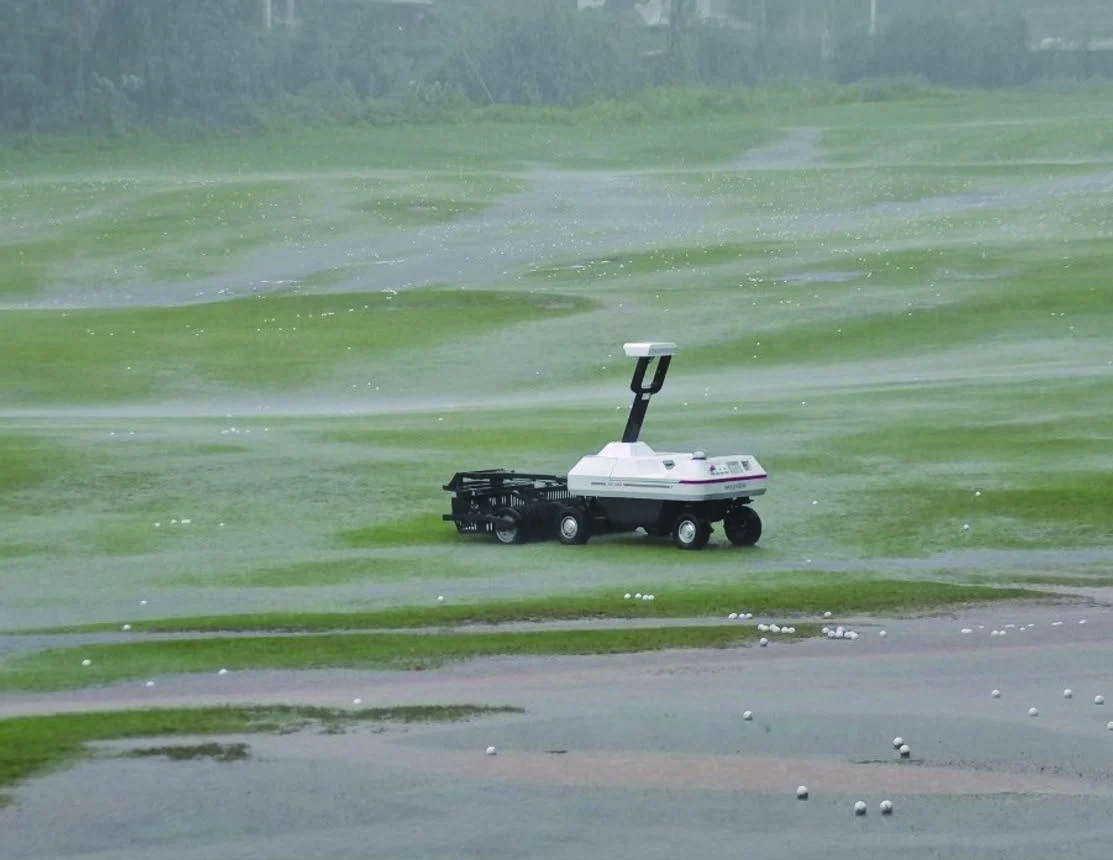
Wayrobo's material shows the machine working in heavy rain and standing water.
Emptying without groundwork
The part that usually kills automation projects is the infrastructure. Wayrobo's answer is an unloading station that stands where you put it — according to the manufacturer no terrain modification or permit is required. The machine reverses into it, which keeps the footprint down to a minimum of about 5 m², and the station can be connected to a third-party ball washer using a lift kit.
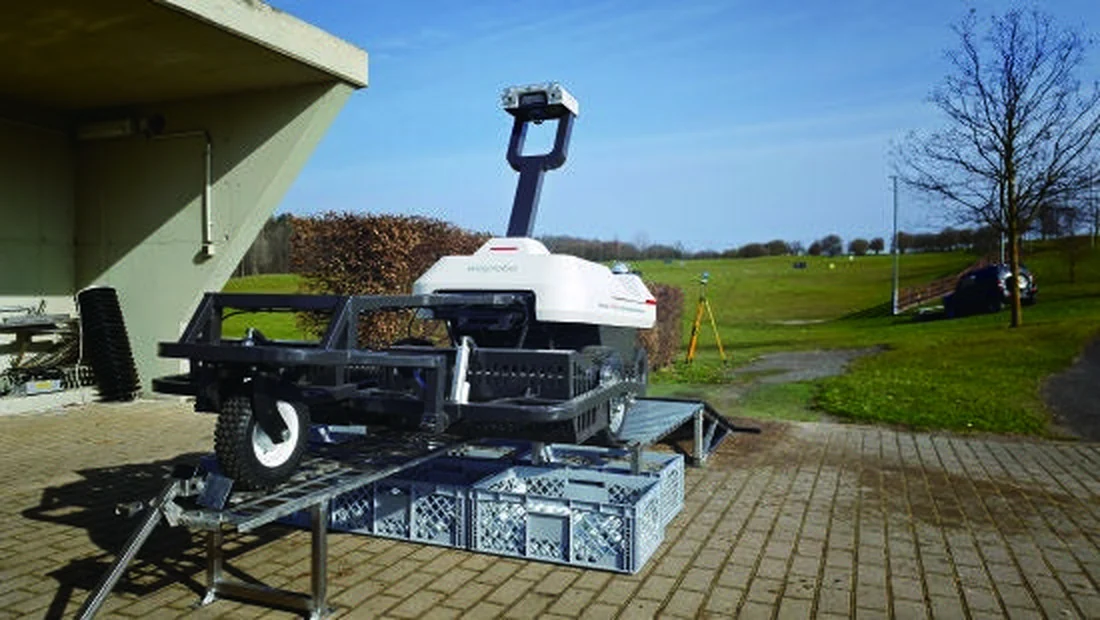
The unloading station is placed on existing hardstanding. The machine reverses in and empties itself.
How does this compare with a ball-picking attachment?
It is a fair question, because FJDynamics — whose robots RoboService does sell — already offers ball collection. The BP01 and BP02 are collectors for the RM21, and the Z42P has its own picker attachment. Underneath the specifications it turns out to be a more interesting question than it first looks, because what you are really choosing between is owning one system or two.
That deserved its own article, with real figures on the side we can actually price: the WayPick 2 against the RM21 with BP02.
What a Swedish facility would need in place
This is where market watch has to stay honest. Three practical conditions come with the concept, and one caveat comes with the market.
RTK coverage. The machine positions itself with GNSS RTK. That means a correction signal — either a base station on site or an NTRIP subscription. This is familiar ground for us: RoboService runs its own RTK network and delivers NTRIP accounts to robot customers already.
Somewhere to put the station, and power to it. The unloading station needs a spot on existing hardstanding with roughly 5 m² of manoeuvring room, and charging takes about 5.5 hours from a 220 V outlet. Note what that means in practice: the machine is charged by cable, so somebody has to connect it. The picking runs unattended; the charging does not. Neither point is dramatic, but both need a decision before delivery rather than after. The unloading station is also an added cost rather than something included.
Terrain within limits. The specification gives a maximum slope of 28 % (15°) and a recommended facility size under 50,000 m². Most Swedish ranges fit comfortably inside that, but a steep bank at the far end is worth measuring rather than estimating.
And the caveat: it is not proven here yet. Wayrobo reports units in operation in Germany, the Czech Republic, Italy and the United States, and has shown the machine at the Japan Turf Show, the PGA Show, GCSAA and ASTMA in Melbourne. As far as we know there is no installation in Sweden — which means no Swedish reference for a full season, a Swedish autumn or a Swedish winter. That is not a reason to dismiss it. It is a reason to be clear-eyed about who would be first.
Where RoboService stands
We think the concept is right. Ball picking is exactly the kind of repetitive, weather-exposed, mildly hazardous work that autonomy is genuinely good at, and doing it at night instead of during opening hours is a real commercial argument rather than a technical one.
We are watching the WayPick 2 and talking to the manufacturer. Nothing is decided, pricing for the Swedish market is not established, and we are not taking orders. If automated ball collection is on your agenda for next season, tell us — the facilities that get in touch early are the ones that shape what we end up bringing to Sweden.
In the meantime, the parts of the operation we do deliver today are worth a look: robot mowing for golf facilities and GolfMind, the platform that turns a scan of the course into usable maps and registers.
Questions and answers
Does RoboService sell the WayPick 2?
No. This article is market watch. We follow the machine and are in contact with the manufacturer, but it is not part of our range and we are not taking orders for it.
What does it cost?
Pricing for the Swedish market is not established, so we are not quoting a figure. If the concept is relevant for your facility, contact us and we will take the question to the manufacturer together.
Can it really work at night?
According to Wayrobo, yes — the machine uses LiDAR, GNSS and headlights and completes its full workflow in darkness. That is the manufacturer's claim; we have not tested it on a Swedish range.
How steep a slope can it handle?
The manufacturer's specification states a maximum of 28 % (15°). If your range has a noticeably steep section, measure it rather than estimate before drawing any conclusions.
How large a facility does it suit?
Wayrobo recommends facilities under 50,000 m² and states a coverage rate of up to 10,000 m² per hour. Note that those are two different numbers: one is the size of the range, the other is how fast the machine works.
What do you actually sell for golf facilities today?
Robot mowers and the systems around them — the RCM01 reel mower for fairways, the RM21P Rough Ranger for rough and semi-rough, RTK subscriptions, scanning and GolfMind. That is where RoboService has real installations and Swedish references.
Is automated ball collection on your agenda?
Tell us what your range looks like and what picking costs you today. Get in touch — no obligation, and no sales pitch for something we do not yet sell.